
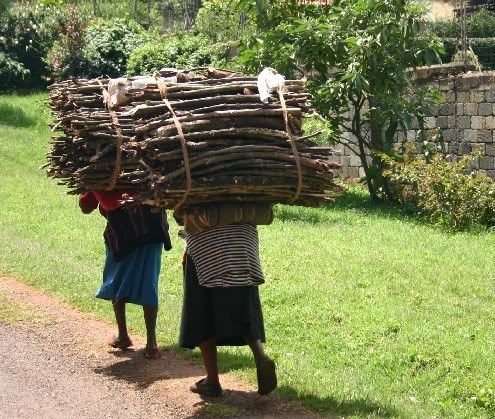
When you move to Africa, nobody warns you about ‘the guilt’. It may be pure self indulgence on my part, but I feel horribly guilty living in Africa as an expat because of the huge disparity of wealth, a yawning gap between the ‘haves’ and ‘have nots’ that hits you smack between the eyes every day. It’s hard to avoid. I must be careful over how I describe this as blog readers may well misinterpret my meaning, but I think it’s an important subject to tackle and very relevant to the expat housewife experience.
When you move to the developing world, you might go about enjoying a lifestyle that’s not dissimilar to the one you left back home in the ‘first world’, often it's a little better, sometimes worse; however the lifestyle of the majority of those around you is always vastly, vastly different. Whether you live in an apartment, a compound of town houses or a lovely old house with a big garden you are confronted by poverty every day. The guilt pangs come when you see a lady bent double carrying heavy firewood; when you pass a man pulling a homemade handcart filled with scrap metal along the potholed roads whilst behind the wheel of your four wheel drive; when you see tiny uniformed children walking to school unaccompanied; when street kids push paper wraps of peanuts at your car window and beggars, some disabled, appeal to you from the pavement with open palms. I'm not a missionary, volunteer, doctor or nurse but simply a 'dependant' on my husband's passport and a trailing spouse, so there are no good works to assuage my guilt.
Most of us find ourselves peeling price labels off olive oil, chocolate, bottles of wine and cheese when we get home because we are ashamed of the fact that these items cost more than the average daily wage. We prefer secure shopping centres because there we are not hounded by (sometimes drug dependant) hawkers who pull tatty pieces of paper from their pocket and spin us a tale of woe and desperation:
‘I need drugs for an illness, here is the doctor’s prescription.’
‘Give me 500 shillings to pay to the guard company who guarantee that I will then get a job. If you give me the money it will change my life.’
The hawkers at the local shops become familiar faces and before long you have heard all the stories before and however much money you give their situation stays the same. While the more canny hawkers try to memorize your children’s names to catch your attention, you might meanwhile gradually become a cynic. Others try to sell random goods that they carry about such as fruits, flowers, an iron or a pair of windscreen wipers and unfairly, it’s easier to say; ‘No thank you, not today’ to them. For an expat woman like me, who is usually preoccupied with manhandling her child out of or into a toddler car seat, carrying bags and trying to ensure her other children are not about to be run over in a busy car park, it is generally not the opportune moment to start discussing finances with a stranger.
Those in your employment will ask you for personal loans, request help with their medical costs and money for school fees. Sometimes you feel that whilst you can put up with: potholed roads, tropical illnesses, extra vaccinations, family and friends living thousands of miles away, less choice of goods to buy in the shops, political unrest, risk of armed burglary, car jacking and street riots, you simply can’t face being asked for more money because your patience has run out completely. If you say ‘No’ to someone who is asking for your help whilst you are in a stressed moment, you will drive off and be dogged by guilt thinking:
‘But look at me, I have so much and I’m refusing to help someone with so little.’
Yesterday, in the supermarket, two very smartly dressed young boys aged around seven and ten asked me to buy them bread – I was bemused.
I suppose the very wealthy Kenyans who live in our area just focus on helping their own family members rather than considering every appeal for money that is thrown at them whilst going about their business? The rest of us perhaps get along by taking each request on a case by case basis. Everyone does their bit to help someone. Perhaps others get hardened to it over the years and stop feeling guilty. Harsh experiences show that you cannot trust everyone and that helping those less fortunate does not necessarily translate to loyalty. My friend who has just paid out for school fees for her house helper whilst wondering how she will pay the fees for her own children asked me today:
‘How do you cope with the guilt?’
I replied:
‘I don’t, even after nine years it’s just always there.’
When you move to the developing world, you might go about enjoying a lifestyle that’s not dissimilar to the one you left back home in the ‘first world’, often it's a little better, sometimes worse; however the lifestyle of the majority of those around you is always vastly, vastly different. Whether you live in an apartment, a compound of town houses or a lovely old house with a big garden you are confronted by poverty every day. The guilt pangs come when you see a lady bent double carrying heavy firewood; when you pass a man pulling a homemade handcart filled with scrap metal along the potholed roads whilst behind the wheel of your four wheel drive; when you see tiny uniformed children walking to school unaccompanied; when street kids push paper wraps of peanuts at your car window and beggars, some disabled, appeal to you from the pavement with open palms. I'm not a missionary, volunteer, doctor or nurse but simply a 'dependant' on my husband's passport and a trailing spouse, so there are no good works to assuage my guilt.
Most of us find ourselves peeling price labels off olive oil, chocolate, bottles of wine and cheese when we get home because we are ashamed of the fact that these items cost more than the average daily wage. We prefer secure shopping centres because there we are not hounded by (sometimes drug dependant) hawkers who pull tatty pieces of paper from their pocket and spin us a tale of woe and desperation:
‘I need drugs for an illness, here is the doctor’s prescription.’
‘Give me 500 shillings to pay to the guard company who guarantee that I will then get a job. If you give me the money it will change my life.’
The hawkers at the local shops become familiar faces and before long you have heard all the stories before and however much money you give their situation stays the same. While the more canny hawkers try to memorize your children’s names to catch your attention, you might meanwhile gradually become a cynic. Others try to sell random goods that they carry about such as fruits, flowers, an iron or a pair of windscreen wipers and unfairly, it’s easier to say; ‘No thank you, not today’ to them. For an expat woman like me, who is usually preoccupied with manhandling her child out of or into a toddler car seat, carrying bags and trying to ensure her other children are not about to be run over in a busy car park, it is generally not the opportune moment to start discussing finances with a stranger.
Those in your employment will ask you for personal loans, request help with their medical costs and money for school fees. Sometimes you feel that whilst you can put up with: potholed roads, tropical illnesses, extra vaccinations, family and friends living thousands of miles away, less choice of goods to buy in the shops, political unrest, risk of armed burglary, car jacking and street riots, you simply can’t face being asked for more money because your patience has run out completely. If you say ‘No’ to someone who is asking for your help whilst you are in a stressed moment, you will drive off and be dogged by guilt thinking:
‘But look at me, I have so much and I’m refusing to help someone with so little.’
Yesterday, in the supermarket, two very smartly dressed young boys aged around seven and ten asked me to buy them bread – I was bemused.
I suppose the very wealthy Kenyans who live in our area just focus on helping their own family members rather than considering every appeal for money that is thrown at them whilst going about their business? The rest of us perhaps get along by taking each request on a case by case basis. Everyone does their bit to help someone. Perhaps others get hardened to it over the years and stop feeling guilty. Harsh experiences show that you cannot trust everyone and that helping those less fortunate does not necessarily translate to loyalty. My friend who has just paid out for school fees for her house helper whilst wondering how she will pay the fees for her own children asked me today:
‘How do you cope with the guilt?’
I replied:
‘I don’t, even after nine years it’s just always there.’
Just a simple and probaly naive question, but why don't the wages you (and other expats) pay cover basics like school fees and essential medical care?
ReplyDeleteIt seems strange to moan about being 'pestered' for help with these things by your own staff when the solution is entirely within your power.
I think you have described this situation with sensitivity. As an American who lived in India for a few years, I can relate to most of what you are saying. As a college student in India, I did live in the hostel along with the local students, following the rules (curfews, dress code, water scarcity, etc) and also the financial situation. I was charged the same as the locals for tuition and lodging and food so I had plenty of extra spending money. Though I spent about US$2k in my two year stay there- includes all expenses, I am sure most of my classmates spent about 1/2 of this.
ReplyDeleteBecause I was studying social work and in the field all the time, I met financially poor people all the time, asking me for money, so I can also relate to that part of the situation. Thanks for sharing!
You supposition about wealthy Kenyans is a big generalisation! My family live all over Kenya. some are wealthier than others. Whenever we get asked for money, we give food, or buy the medicine or whatever is being asked for. like all humans, sometimes it gets tiring, it wears you down always being asked for money. People assume that because you/your children/family live abroad, you're mega rich. They forget that you've got your mortgage and bills to pay too! So no, it's not just expats who feel the guilt. We wananchi have hearts too - believe it or not!
ReplyDeleteI know it's a touchy subject but I'm glad you brought it up. It's a fine line to straddle. I think what adds to it is most Brits (and Americans, like me) don't like discussing money so openly.
ReplyDeletethanks once again for your blog. I was just wondering reading your blog and asking the question, how many people can you really help? And how far does that help go? What if the same people you help have made it a habbit to seek your help because they expect your sypathy? Being a kenyan and having lived in the UK for seven years and only visited home once in the seven years, we made a decision to buy a house in Kenya. The whole transaction was done whilst we were in here in the UK. When we got back in Kenya we had an arrangment with the vendor to take ownership before the whole transfer process was completed. The catch was, the vendor had a caretaker who was living in the SQ and he was to live in the SQ until the sale was completed. He got used to us and we were ofcourse considerate of his well being. We had a situation after the sale was completed because we expected him to move out as agreed by the vendor. Actually the vendor was paying him whilst he was living there because he was in a way securing the compound. One early morning I had a car pull up at the gate and being a sunday we were still in bed.It was actually the vendor who had come to tell the caretaker to move out since we now fully owned the house. He didnt want to move out out since he did not have a job to go to. He came to me and asked me whether he could stay for three days whilst he looked for somewhere to live. I rang my solicitor for advise and she wasnt having none of it and he rang vendor straight away. The vendor himself came to our house that morning and when I made it clear that I was worried that they were going to leave the caretaker by some roadside without anywhere to go, the vendor had a different story. He said that the caretaker knew that he had to move out and they were taking him to his brother. He made one thing very clear and if I can quote him "You people (to mean me and my wife), if you dont style up, you will be taken advantage of by everyone. Remember you are now in Kenya and you have to make tough decisions." They took the caretaker away and said that they were taking him to his brother. The point is , did I feel guilty, yes I did. The question is, how many people can you support and how do you establish how genuine they are? Should you feel guilty every other time because you have a slightly decent life? If all what you have and have worked for all you life was not handed to you on a plate then you reserve the right to help only when you can and that doesnt mean helping everyone. If you were a corrupt Kenyan politician who has grabbed millions from the public coffers then you deserve to live in guilt. Believe me,your Kenyan neighbours are likely to be as well of but not as generous. By the way our story ended by us not really coping in our own country and guess what we are back to the UK. Not all hope is gone and am just preparing for the second homecoming and am promising myself that when that time comes, I will be prepared those tough decisions I was told to learn to make. By the way reading your blog has made me look at life in Kenya from a much wider perspective!!!!thanks
ReplyDeleteI am moved to add another comment-
ReplyDeleteAfter reading the first comment- I beg to differ- in any country in any place just because a person with money gives it to someone who needs it- what's the assurance it will be used for the requirement? IT's not always so straightforward. In both my experience in social work career in US and in India, often rather than give the money directly to the person, we were advised to physically help that person use that money for what is desired/required. Often times when we mentioned we had to physically help them use the money for (food, medicine, doctors visit, etc.) the person would deny the money. Others who agreed after this discussion did so because they knew if we had given them the money for this, their neighbors would be suspicious and may try to steal it from them. The most vivid example of this was when we helped a one-legged boy get admission into the hospital to have his absent leg replaced. It is noted that in these cases, these people all lived in slum areas in Chennai where the politics is heavy and influences everything that happens even on a daily basis.
No, that guilt doesn't ever leave but, as some of your commenters point out, you can't help everyone.
ReplyDeleteI think the best thing for expats to do is help those they can - if you gave money to every hawker/bought every puppy on Westlands roundabout etc would you really be helping?
I think all expats have a duty to assist their staff (within reason) and remember that we do not live in an ideal society where everyone has everything they need.
Interesting post. I wonder if the guilt is heightened (or indeed is caused) by the difference in colour that usually goes with being a white expat in a non-white country. Since discussing such issues with candour [and in your case sensitivity] is made easier with the anonymity of blogging I would be very interested if you expanded on this subject with a follow up about how people in Kenya manage money - and I'm not talking about the poor and the modestly well-off, but the rich too. Do you discern distinct patterns?
ReplyDeleteBTW, what interested me most about this post of yours is that you've been in Kenya for 9 years - and are still troubled by such issues...
quite interesting!.THE guilt should not be there,learn to ignore people and only give help where needed,not money,even to your staff,-they should learn how to take care of and plan their salaries. I say this bbecause I come from a village where evreyone thinks we are rich and people always wanted money and favours.My mum had to become harsh,despite what people thought and said,though its impossble to ignore someones plight,get tough.My mum stopped feeling guilty and gives food or pays fees directly to the school or pays the hospital bills only when sure its right to do it.At first it was hard but people learned and adapted and no longer take advantage of her kindness.
ReplyDeleteI also wonder,how do the local europeans handle the situation?,I noticed people can differentiate quite easily between a kenyan european and a foreigner and things they ask are different-they ask for jobs in the farms or ranches,but will ask for money from you,and generally fear approaching local europeans!
musyoka
Fell the shame if you're to blame but, as someone once said, the poor are always with us. You're no more responsible for the Kenyan poor than you were for the UK poor and con artists exist everywhere as do the genuinely needy.
ReplyDeleteGive what you can when you can where it will do the most good (as you would at home) and feel the glow of decency. Be generous to your staff if you can but don't feel bad about saying no, they are, after all, just staff.
However, the presumed automatic right to the contents of your pocket or your property and your vulnerability to being played like a violin is actually very cheeky and darkly funny. They don't feel any shame about manipulating you so protect yourself and substitute wisdom and good humour for cynicism and certainly ditch your own guilt, it doesn't make you a better person.
First, I commend you for indulging us in your daily thoughts and experiences in my beautiful country Kenya. I am a kenyan living in the US and I find your blog interesting and it's become almost like a cup of chai - necessary.
ReplyDeleteThis is an interesting topic and I'm glad you were bold enough to discuss it. It's humane to consider others plight - we shouldn't feel guilty about that but the truth is we do. How we deal with it? What we do as a result? maybe that's what counts.
But how many of us are really in a state to do much - e.g I think really big in terms of how I'm going to help my Kenya and most of the time my resources are limited.Counting the the cost of that sacrifice doesn't help either. I have a family of my own to take care of. I day dream about all the projects I can undertake in Kenya and how I can rally friends to help then I realize that I have extended family in some form of poverty somewhere that I could be helping directly. And that I should start there. So on most days I'm at crossroads on what to do about that situation so I start where I am - here - now; I give towards missions in my church knowing it will touch someone somewhere. I see the lives it's touched and then for that day I know I have done my part. I guess that's what it comes down to . . . do what you can!