
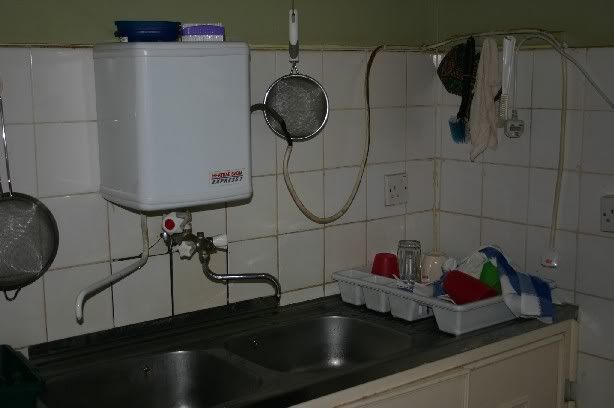
We have a small problem in our kitchen, because our little electric water heater that is mounted inches over the sink, with a thick cable that plugs into the wall to turn it off and on, has finally packed up. The cable that has broken free of it’s wall mountings and has been dangling dangerously close to the water in the sink for some weeks, always gave me the fear of sudden death by electric shock and it has been five years of irritation banging your head on this silly protruding water heater box as you bend down to fish out rogue knives and spoons from the bottom of the washing up water. No doubt, it has driven Gladys and Florence mad over the years too, as they put in many hours of washing up by hand each week. It’s a very Heath Robinson/1950s system that is in dire need of an upgrade. The problem is that, now we have bought the house, I’m looking at everything with new eyes. One day I’d like a new kitchen, a new bedroom for our youngest daughter who sleeps in a box room under the sloping roof, a second bathroom upstairs hell – one day I’d even like a swimming pool! Not sure if or how any of this will take place but it leaves us in a dilemma re: fixing kitchen hot water heater because one day I’d like to pull the whole lot down and start again, therefore much more than a temporary fix would be a waste of effort and money.
It’s tiresome washing up in cold water, or boiling the kettle to wash up, or carrying buckets of hot water from the upstairs bathroom, but yet another antiquated water heater system seemed so old fashioned that I asked the plumber:
‘Couldn’t we just run hot water into the kitchen from our upstairs boiler perhaps, like in 21st century houses?’
At this point I might just explain that strangely enough our water pipes are mounted on the outside of the house. There is a ground tank for water storage which is sporadically topped up by the mains supply that comes in on one or two random days of the week (if at all). We then have a small electric pump that we switch on and off to get the water from the ground into the roof tanks. The water must be routed around the house (ie upstairs/guest room extension/outbuildings) via a complex system of turning on and off of valves mounted on the pipes outside on the wall. We switch the pump off when precious water starts pouring out from the various overflow pipes onto the ground.
It’s tiresome washing up in cold water, or boiling the kettle to wash up, or carrying buckets of hot water from the upstairs bathroom, but yet another antiquated water heater system seemed so old fashioned that I asked the plumber:
‘Couldn’t we just run hot water into the kitchen from our upstairs boiler perhaps, like in 21st century houses?’
At this point I might just explain that strangely enough our water pipes are mounted on the outside of the house. There is a ground tank for water storage which is sporadically topped up by the mains supply that comes in on one or two random days of the week (if at all). We then have a small electric pump that we switch on and off to get the water from the ground into the roof tanks. The water must be routed around the house (ie upstairs/guest room extension/outbuildings) via a complex system of turning on and off of valves mounted on the pipes outside on the wall. We switch the pump off when precious water starts pouring out from the various overflow pipes onto the ground.

Finally I get to the point – the plumber shook his head and said, that my plan might be difficult; however, he said he would be back the next day with all the necessary equipment. Sure enough he returned, with a long ladder, a length of pipe and a sledge hammer. I returned from a quick shopping expedition to find that the plumber’s assistant was up the ladder and proceeding to knock a large hole in the side of the house:
‘STOP!’ I yelled.
It was then that I learned about the plumber’s ‘grand plan’, whose details were as follows: knock a hole in the side of your brown stone Nairobi house, big enough to poke a human head through in order to locate roughly where the upstairs bathroom taps are mounted. Then try to make an ancillary connection with the hot water pipe under the upstairs bath to a new pipe, that will poke out of the external wall, run vertically down the outside of the house (in amongst all the other ones in the maze). A guess will be made at roughly where the underside of the kitchen sink is, knock another hole in the house for the pipe re enter, run it up to the kitchen sink – then bodge a new hot water tap and hey presto! Hot water in the kitchen!
‘OK, forget it.’ I said to the plumber and his mate. ‘Sorry to be awkward and to have wasted your time, but we are going to have to think of another solution.’ I then proceeded to have a row with my husband, in front of the bewildered plumbers, who was insisting that all houses, even in England, have water pipes that run down the outside walls. However, at the risk of believing I was slipping into insanity yet having just been to England, I was sticking to my guns.
‘No more horrible pipes on the outside of the house!’ I insisted. ‘Houses in the developed world do not have pipes on the outside, with little electric pumps plugged into a stupid socket and valves dotted here and there. I’d rather do without the hot water than knock huge holes in the side of the house – this is crazy!’ Finally, my husband acquiesced.
On closer inspection, under the sink were two disused pipes which suggested that once there was a hot and cold water supply to the kitchen, however, we are now back to square one, with no progress made. A week later, we’re still boiling kettles for washing up and still living in the 1950s in Nairobi. It seems that I can only dream of hot running water, dish washers and no more unsightly exterior water pipes.
I am thinking that an enterprising ,adventurous plumber from out here might do really well if they set shop in Nairobi. Being Kenyan I shouldn't be surprised at your plumbers antiquated modus operandi but, having been away for a long time, I actually am. We have never really invested in training tradesmen or having regulating standards that might maybe bring the professions to the 21st century. Ok you have rogue traders out here but at home everything is soooo jua-kali.
ReplyDeleteThe outside pipes are ugly, but imagine the nightmare if they were in the walls or under the floors and then you had a problem and had to get the rather enthusiastic plumber to find the fault .... images of holes knocked in walls, flooring pulled up etc etc .. also, I think in UK they are in the walls because of freezing ... ?
ReplyDeleteWhat you are asking for is not out of the ordinary, I lived in the 70's and 80's in Westlands, and Lavington with a large water heater upstairs (in a closet by the upstairs bathroom), that fed all the kitchen, bathroom, and showers downstairs with hot water. We could have the upstairs shower, and the downstairs shower going on at the same time, and still have some leftover to run the washing machine. All the pipes ran inside the house, in the walls, out of sight.
ReplyDeleteMaybe the Karen Country Club facilites people might know of a plumber who does what you want?
Sorry for your plumbing predicament!!!Am kenyan an living here in your home country! Perhaps I should shade some light to your plumbers demolition. The difficulty with getting pipes through the interior of the house in Kenya is because of the way the houses are built. I presume if you have a double storey then the first floor is solid concrete and that will really take some doing to create even the smallest of holes for the pipes to get through. Believe me, its easier to knock a hole through the stone than through the 6 or 10 inches of concrete!!! Its easier here in the UK since the the top floors are just mere wood and all you need is take off the wook flooring and it takes a couple of minutes to lay the pipes.My advice would be foor your plumber to drill a hole in between the mortar that seperates the stone then he will be able to get the pipes out, but then I guess he might not have a drill for such kind of job. The other way to make the pipes discrete is to chisel out trunking for the exterior pipes then once the pipes are laid re-plaster the whole place and gone the unsightly pipes!!!!! As for your little pump,you could make asmall investment in a float switch , some wiring will be done and as soon as the water in the upper tanks fall below a certain level then the switch automatically cuts-off - its a much more efficient way. The piped water in Kenya has a very low pressure and thus the need for the pump. I have always borrowed some ideas from here in the U which I have always implemented back there at home and they have always worked fine. Perhaps when I come back to Kenya foor a visit or to settle I might just offer my consultancy services - at a small fee!!!!! thanks for you blog.
ReplyDeleteThank you so much for all of your suggestions and comments! Ben, please come and set up a business back here in Nairobi! Properly trained plumbers and electricians are impossible to come by here and your help would save many an expat housewife from tearing out her hair when trying to overcome such predicaments!
ReplyDeleteFriends endlessly complain of septic tanks backing up, shower trays leaking, water coming up through tiled bathroom floors, electrics blowing up because of a badly wired water pump... the list is in fact endless.
As a recent expat arrival in Nairobi, your plumbing story makes me laugh to the point of crying. I have spent the last 2 months fighting with our landlord to make get hot showers in our very new house (despite having 6 water heaters)... I had one energy efficient high pressure geyser supplying more taps in my previous home. Your plumber certainly sounds more industrious than the many we have had through our place! Can’t wait to see what happens when you need an electrician…
ReplyDeleteIf you cant read the whole post, the message is " LOOK IN THE RIGHT PLACES".
ReplyDeleteI believe this post is kind of out-dated. But the comments out here warrant my interjection.
Nairobi is a big place and you will be surprised by the number of higly trained tradesmen who are dying to get an opportunity. You just have to know where to look.
Look, you have to place everything in perspective. Even here in Canada, there are quarks masquerading as professionals. If you decide to ask the guy at the corner kiosk to recommend a plumber ofcourse, you are bound to get that one inexperienced bloke, trying to earn a living. Hes got to call himself something if he is to earn some money.
Cut the long story short. Whatever you guys are talking about in terms of plumbing and electricians, you are better off to start in places like the Railway institute, Kenya poltechnic, the Don Bosco tade schools and they can refer you to scores of highly trained (and I dare say highly qualified, I know several!!!) and jobless students, wallowing somewhere in Nairobi, waiting for a break. I have done more complex things that replace water tanks or lay piping.
Sorry for the long post